Total Pageviews

Saturday, 14 June 2014

Ernest Gidley 1878 - 1917


Ernest Gidley was the second oldest of the Gidley men to die, being aged 38. He was one of the three naval casualties, all the others being soldiers. He was a Petty Officer Stoker on the destroyer HMS Pheasant when it was sunk by a mine off the Orkneys on March 1, 1917.
Ernest was born on Sep 19, 1878 (although his naval record says 1881), the youngest child of John Gidley, a sawyer of Buckfastleigh, and his wife Elizabeth, nee Baker. Dean Prior and Buckfastleigh are close together, there was a lot of movement between them over the years, and Ernest's family's ancestors are actually the Dean Prior branch of the Gidleys, not the Buckfastleigh branch.
At the age of 13 he was already a yarn presser,contributing to the family income, and it seems he may have accompanied two of his older brothers to Lawrence, Massachusetts at some point. They emigrated there to work in the textile mills. Ernest certainly travelled there in 1897, when his occupation was given as a lamp maker. But in 1904 he signed on for 12 years in the Royal Navy and by 1911 he was a Leading Stoker, serving bases in Singapore and Hong Kong (the China Station), on HMS Monmouth, and on depot and training ships at Plymouth. He married Thirza Jane Barnes in 1908 and their only child Cecil Gidley was born in Buckfastleigh, Devon, later that year. Cecil was the father of Brian Gidley, the actor and singer, who emigrated to New Zealand.
In January 1917 Ernest boarded HMS Pheasant, a destroyer. It was sunk with the loss of all hands when it hit a mine off the Orkneys.
From the Scapa Flow landscape website I found the following:
"On the 1st of March 1917 she had sailed to conduct the `Hoy Patrol’ a local patrol around Hoy. During the week she lay at anchor in the Flow at night and patrolled outside Hoy Sound by day. She was ordered to send a weather report at 5.30am as the commodore of Destroyers planned to hold gunnery practice for his ships. She was seen by the Signal Station at Stromness at 5.30am and at 06.10 am a loud explosion was heard. Men on two trawlers anchored inshore heard the explosion and from one of the trawlers they could see black smoke.
One of the trawlers (the Grouse) immediately set out in the direction of the smoke but found nothing. The ship had disappeared. Later that morning a group of minesweeping trawlers discovered a patch of oil and wreckage and the body of midshipman Cotter was found wearing two lifebelts. At least 88 men had been on board but his was the only body recovered. He is buried in the Lyness Naval Cemetery.
It was assumed that the ship had struck a mine, possibly one that had broken loose from the Whiten Bank field (a British defense) which was laid in the winter of 1915-16. Another suggestion is that she was sunk by UC-43 – a submarine minelayer. It is known that this submarine sailed on the 25th of February and she was sunk by HM Submarine G-13 off Shetland on the 10th of March."
In 1996 the wreck of HMS Pheasant was discovered.
Ernest is commemorated on the Plymouth Naval Memorial.
His parents, John and Elizabeth Gidley, both died in the December quarter of 1918. In a horrible co-incidence, another son, Samuel, one of the brothers who emigrated to Lawrence, Mass., also met his death by drowning, but in an accident whilst on holiday at Salisbury Beach in 1911.

William George Victor Gidley 1896 - 1917


1917 was the worst year for Gidley deaths in the war, seeing nine men killed, more than double the next worst year's total of four in 1918.
William Gidley was killed in action on February 7, 1917, aged 20. He was a Private in the Border Regiment, having originally joined the Essex Regiment. He was also the one I found most difficult to trace, until I downloaded the "soldier's will" he made, leaving all his possessions to his mother, Eliza Gidley.
William was one of the seventeen children of Charles Edwin Gidley by his two wives. William was a child of his second marriage to Eliza Anderson. Eliza could also be called Charles Edwin Gidley's stepsister, being the daughter of his stepmother by her first marriage. It is not known if Charles Edwin's families by his two wives were in contact. Probably not, as he had moved in with his second wife before the death of his first wife, Jessie. Charles "married" Eliza in 1905, but they also went through a (finally legal) second marriage ceremony in 1907, after his first wife Jessie had died. In 1911 on the census form they claimed to have been married for nineteen years. Charles Edwin's ancestors originated in Buckfastleigh, Devon.
William was probably a conscript. In 1911 he was living at home, with no employment. His father Charles Edwin was a motor bus engineer of 38 Edinburgh Rd, Plaistow in East London.
William's Medal Rolls card gives no details at all of his service record, but he wasn't awarded the 1915 Star, just the Victory and British medals. Presumably he served in the Somme sector, when the Germans were just falling back to their newly prepared defences, the Hindenburg Line, just before they mounted their major offensive in March 1918.
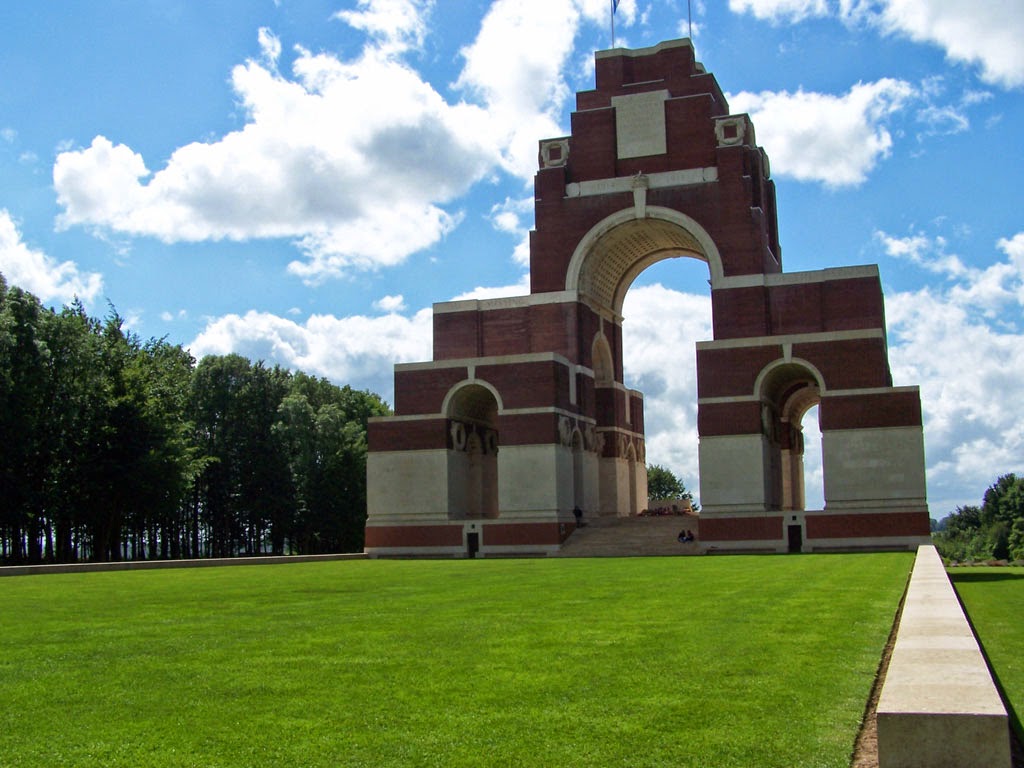
He has no known grave, but is commemorated at Thiepval.
His half brother, Sydney Herbert Gidley, was killed a few weeks later.

William Gidley 1893 - 1916


William Gidley was a Sergeant in the Duke of Wellington's West Riding Regiment, 9th Service Battalion. He was killed in action on July 7, 1916, just six days after Richard Gidley in the previous post, also at the Battle of the Somme.
William was the son of Herbert Gidley and his wife Alice Maud Mary Anne, nee Collinson. He was born in Bradford on October 24, 1893, the second oldest of eight children. Herbert Gidley, his father, was a bookkeeper at a textile factory in Halifax in 1901, and in 1911 a clerk, at a cotton and wool dyer's. William in 1911 was a labourer, possibly at the same dyer's, living at home at 4 Godley Road in Halifax. They were part of the Gidley branch which could trace its roots back to Dean Prior in Devon.
William was also a volunteer and landed at Boulogne in July 1915. He was awarded the 15 Star, the Victory and the British medals. He also has no known grave, and is commemorated at Thiepval.
Sadly, his older brother Harold was killed nine months later.

Richard Gidley 1898 - 1916


Richard Gidley was born on August 11, 1898 and was killed on July 1, 1916 at the age of 19. He was a Private in the Devonshire Regiment.
Richard's life seems to have been difficult from the start. It began at his birth in the Union Workhouse in Okehampton, Devon, where his unmarried mother, Bessie Gidley, a servant, had gone to give birth to him. It seems likely that he never lived with his mother, as in 1901 he was boarded out with a local family, and in 1911 he was still a boarder with them. He may never have lived as a family with his older sister, Bessie, or his younger brother Reginald, for Bessie Gidley, a kitchen maid at the White Hart Hotel, Okehampton, had three illegitimate children in total. She was the tenth of eleven children of George Gidley, a cooper of Throwleigh, Devon, and his second wife Ann Howard. They were from the Winkleigh Gidley branch. Bessie may have died in 1906 in the Plymouth area, and Richard's grandmother, Ann Gidley, was living in Torquay with her youngest son in 1901 and 1911.
Richard seems to have joined up very early in the war. According to his Medal Rolls index card he arrived in France in May 1915. On July 1st 1916 he was "regarded dead", just one amongst the 57,000 casualties of the first day of the Battle of the Somme, for an advance of just one mile. He was awarded the 15 Star, the Victory and the British medals. He has no known grave, but is commemorated on the Thiepval memorial.

Geoffrey Damarel Gidley 1896 - 1916


Geoffrey Damarel Gidley died on May 30th 1916, aged 20. He was a Lance Corporal in the London Regiment (Queen Victoria's Rifles).
Geoffrey was born in 1896 in Ladbroke Grove, West London, and christened in Notting Hill. He was the fourth of five sons born to George Gidley and his wife Annie Maud, nee Sharp. There were also two daughters. Geoffrey's father George was, together with two of his brothers, a tailor in Shepherds Bush, West London. The family had originated in Chagford, Devon, and was part of the Winkleigh family of Gidleys.
Geoffrey was evidently a bright lad. He did not follow his father into the family tailoring business, but in 1911 was a clerk in a barrister's office, living at home in Shepherds Bush.
I came across Geoffrey's name in the latest edition of the school magazine for Latymer Upper School, Hammersmith, whilst looking for my uncle's obituary, for both he and my father later attended Latymer Upper (my husband did too, much later). All of them gained scholarships there. In the Latymerian magazine of January 2014 Geoffrey Damarel Gidley is described as falling at Gommecourt, on the first day of the Battle of the Somme, but I think that could be an error, as the first day of that battle is usually given a date of July 1st 1916, one month after Geoffrey died.
The names on Chiswick's war memorial have all been well researched and I am indebted to their website, Heroes of Chiswick, for the following information. The website quotes from The Chiswick Times of 9 June 1916:
"“Geoffrey Gidley was a very keen scout, and was the first member of a diocesan troop in London to gain the coveted “King’s Scout” badge. His early days as a scout were spent in St Stephen’s, Shepherd Bush Troop, from which he transferred to the 3rd Chiswick when coming to live in Chiswick.
A memorial service was held at St Michael’s, Sutton Court, on Wednesday evening, Holy Communion having been held in the early morning, when the 3rd Chiswick Troop and a contingent from St Stephen’s, Shepherd’s Bush, attended. The 1st, 2nd, 4th and 5th Chiswick Troops were represented by their patrol leaders. Mr T. Edwards Forster, J.P. (president of the Chiswick Scouts’ Association), District Scoutmaster and Commissioner H. S. Martin, and Scoutmasters H. Garlick, P.J. Lupton, F. Bransdon and L. Wilkinson were also present. The hymns “Nearer, my God, to thee” and “Fight the Good Fight” were sung, and the choir gave a really beautiful rendering of “O rest in the Lord”. The Rev L. McNeill Shelford conducted the service and gave an address. A colour party was furnished by the 3rd Chiswick Troop, consisting of Patrol Leader F. Robinson and Scouts Goffin and Simpson. At the conclusion of the service the Dead March in Saul was played, followed by the first verse of the National Anthem. Mr. and Mrs Gidley, who live in Burnaby Gardens, have reason to be proud of the record set up by their five sons. In addition to the one just lost, their married son, George William, has just joined as a private in the A.S.C. Julian Norman is a second-lieutenant in the R.F.A, and Robert Dudley is a cadet in the Queen Victoria Rifles. Their remaining son is a member of a volunteer corps in Burma. Mr and Mrs Gidley’s daughters have been married during the past twelve months in St Michael’s to Lance-corporal F. L. Edgar, Queen’s Westminsters, and Sergeant W.J.S Cook, London Scottish, both of whom are in France.”
The website also quotes from the parish magazine of St Michael's, Chiswick, as follows:
"Geoffrey Damarel Gidley enlisted with Queen Victoria’s Rifles (QVR) in September 1914 (The Chiswick Times edition of 18 September 1914 includes his name in its weekly update of local men who had joined up, under the heading “Chiswick’s Brave Sons”), and soon rose to the rank of Corporal. He entered France on 17 August 1915, but owing to his skill in training men was kept at base until about a week before his death. In fact he had only been in the firing line a few hours when a shell struck the rough dug-out in which he was, injuring him very severely. He was able to be moved to a clearing station, but died of his wounds the same day – 30 May 1916."
Geoffrey is buried in Doullens Communal Cemetery Extension no. 1, which was apparently used by several casualty clearing stations. He was awarded the 15 Star, the Victory and the British medals.
Sadly, Geoffrey's younger brother Robert Dudley Gidley was later killed in the war, and a third brother, Douglas Gidley died in 1920 in Burma. A cousin, Frederick William Gidley, was killed in 1917.

With thanks to the researchers of The Heroes of Chiswick website.

Thomas Edmund Gidley 1890 - 1915


Thomas Edmund Gidley was the first Gidley to die in the war and was a Private in the Manchester Regiment.
He was the the elder son of Arthur William Gidley and his first wife, Mary Jane, nee Cheetham. In 1911 Thomas was a packer of calico goods, working for a shipping house, and living at home in Salford, Lancs. His mother had died in 1902 and his father had married again. The stepmother, Annie, was blind by the 1911 census.
In 1912 Thomas married Mary Jane Lee in Salford and they had two children, Annie born in 1913, and a son called after his father, Thomas Edmund, who, tragically, was born only five weeks before his father's death. Thomas's widow married again in 1920.
Thomas Edmund must have joined up very early in the war. It seems that he was already serving in September 1914, departing for the Middle East. He was killed on May 18th 1915 at Gallipoli in the ill-fated Dardanelles Campaign, having landed probably only a couple of weeks earlier, to reinforce the British beachhead. His Medal Rolls index card records that he died of wounds. He was awarded the 15 Star, the Victory and the British medals. He is commemorated on the Helles Memorial in Turkey, pictured above.
The Dardanelles campaign against the Turks was intended to divert the Ottoman Empire from disrupting British oil supplies in the Middle East, from attacking the Russians in the Caucasus, and from cutting off access to India.

Gidleys who fell in the First World War 1914 - 1918

There were seventeen Gidleys who went off to fight and never returned, and it seems fitting to remember them in this centenary year, particularly if they don't have any descendants to remember them. Their ages ranged from 41 down to an unbelievably young 17, with an average age of 26. Some were volunteers from very early in the war, others were no doubt conscripted men, following the introduction of conscription in 1916. To meet the demands of the fighting, by May 1916 even married men between the ages of 19 and 40 were required to register for military service. I'm not sure who were the braver -those who volunteered right from the start, or those who went later, already knowing what horrors they were going to. The following blog posts commemorate those who didn't return, but there are several Gidleys who survived, but whose lives were changed for ever by the wounds they suffered.
The seventeen Gidleys who died were from three branches, the Gidleys of Dean Prior, of Winkleigh, and of Buckfastleigh. If we count the Dean Prior and Buckfastleigh men as one branch (they probably separated in the 17th century), then they make up by far the largest number of those killed - eleven. The remaining six were all from the Winkleigh branch. My own family, which originated in Spreyton, lost no-one in the war. My own grandfather was considered unfit to fight, following a childhood leg injury (he fell off a wall in Heavitree, Devon, scrumping for apples, and was later very glad he had, although the leg never healed properly and he always limped).
Tragically, there were three pairs of Gidley brothers killed, and of those pairs, one also lost a first cousin.
No Gidleys from the USA, Canada or Australia were killed, as far as I can ascertain, although many of the Americans fought. New Zealand is represented by one of the last to die, Robert Northleigh Gidley, an apiarist of some distinction.
The huge loss of life in the First World War is mirrored by Gidley casualties in both that war and the Second World War. There were far fewer in the Second World War. Between 1939 and 1945, although there were more casualties from Gidley families in the USA, and another from an Australian family, in Britain there were only two, and only one of those was due to the fighting. The other was a serviceman who was killed in the London Blitz. I shall commemorate them all at a later date.
If anyone reading this has any photos of these Gidleys I should of course be very pleased to add them to the blog posts, also if they have any more details of thier lives. I know only what is in the public domain. Family members may have more stories to tell of bravery. And I'm not a military historian. I have tried to put their deaths in context, but may well not have got it completely accurate.